When you turn on a collection in the list of sources, its filters show under it. They keep the search to the decisions you need: one court or one level of courts, one kind of decision, one procedure, one area of law or one period.
Where the filters are
Under the question field, press the sources chip. By default it reads Sources: Auto. Turn off Auto, then turn on a country and one of its collections. The filters of that collection show under it.
- A filter with a list takes one value or several. The search keeps the decisions that match any of the values you pick.
- Different filters work together. A decision must match each filter you set.
- An empty filter does not narrow the search. It shows its placeholder, for example Any procedure.
- A filter you set holds for every search the chat makes in that collection, and it stays with the chat until you change it.
The court filter
Each country’s case law has a Court filter. Type a part of a court’s name to search the list, and pick one court or several. Empty, it reads Any court. When you set Court level first, the list shows only the courts of that level.
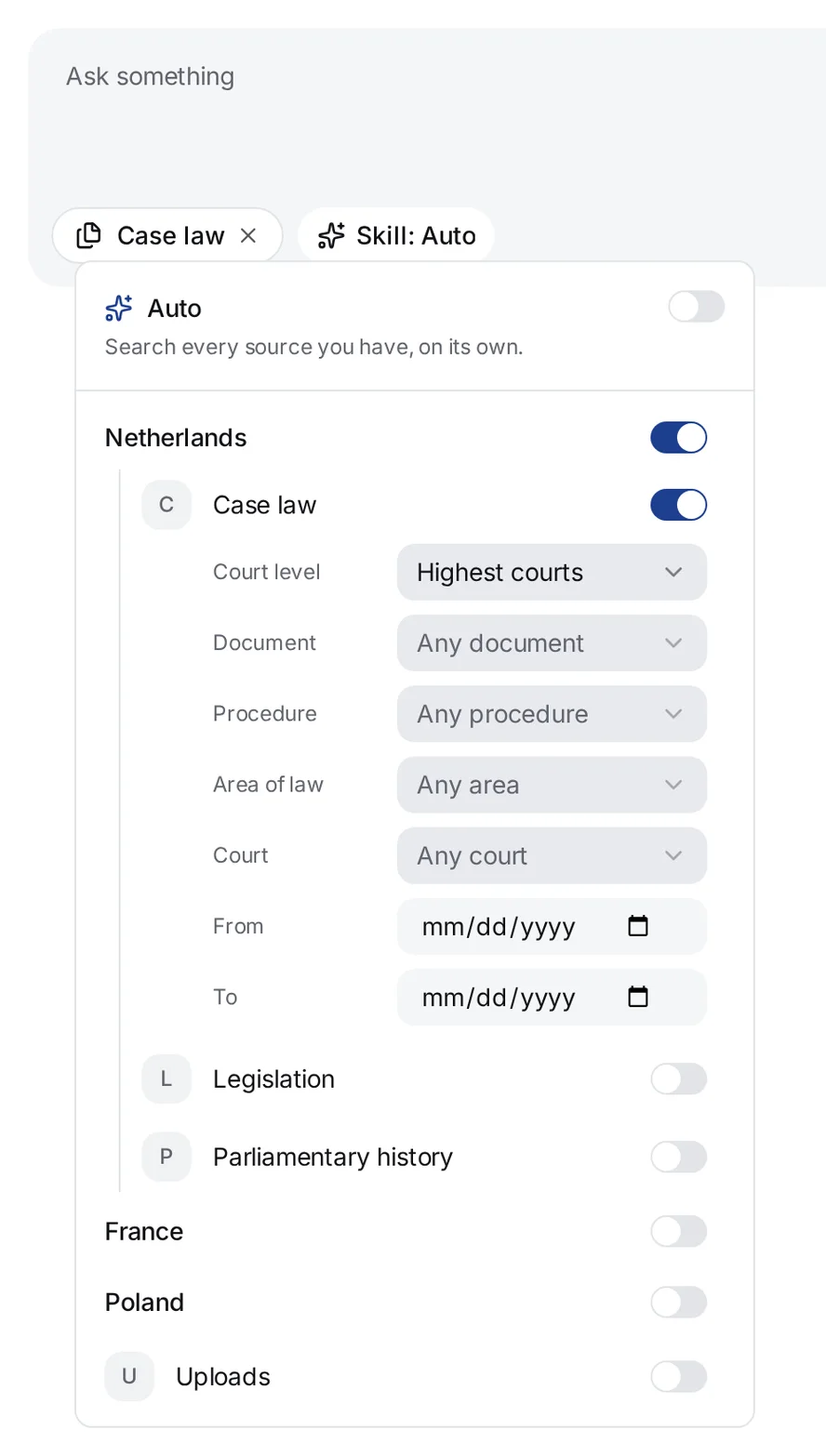
Netherlands: Case law
- Court level — First instance, Courts of appeal or Highest courts. Empty, it reads Any level.
- Court — see The court filter.
- Document — Decision, or Opinion of the Advocate General. Empty, it reads Any document.
- Procedure — the procedure as the Dutch judiciary records it, in Dutch: for example “Eerste aanleg - meervoudig”, “Hoger beroep”, “Kort geding” or “Voorlopige voorziening”. Empty, it reads Any procedure.
- Area of law — the area of law the judiciary gives the decision, in Dutch: for example “Civiel recht; Arbeidsrecht”, “Bestuursrecht; Belastingrecht” or “Strafrecht; Strafprocesrecht”. Empty, it reads Any area.
- From and To — the period in which the decision was given.
Netherlands: Parliamentary history
- Series — the kind of publication. Empty, it reads Any series. The list shows:
- Parliamentary papers (Kamerstukken);
- Debates (Handelingen);
- Answers to written questions (Aanhangsel);
- Bulletin of Acts and Decrees (Staatsblad);
- Government Gazette (Staatscourant);
- Treaty Series (Tractatenblad).
Netherlands: Legislation
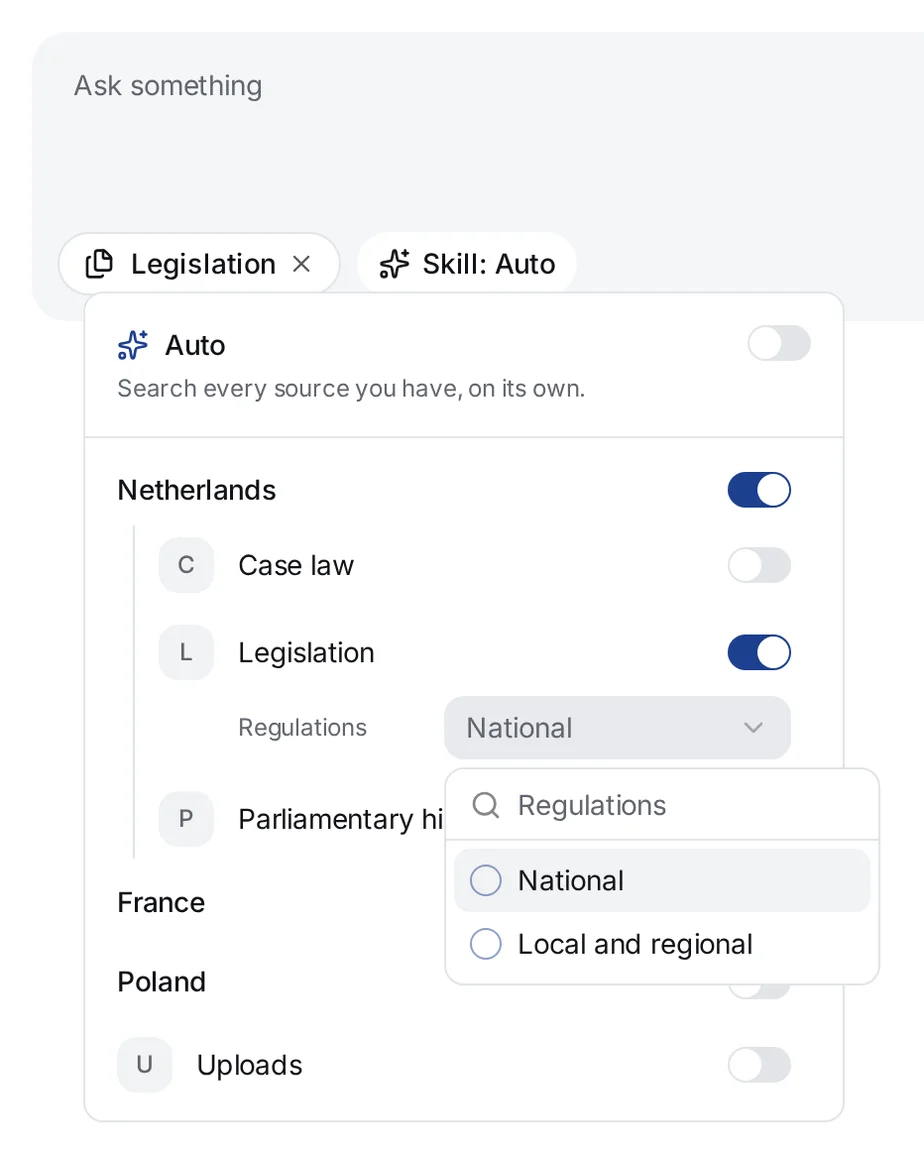
- Regulations — which body of regulations to search:
- National — the Basiswettenbestand: the statutes, the orders in council, the ministerial regulations, the royal decrees and the treaties.
- Local and regional — the regulations, policy rules and byelaws that a municipality, a province or a water board made for its own area.
When you pick nothing, the filter reads National. jurispraxis.ai then searches the national body, and turns to the local body when your question is about the rules of one authority. Pick both values to search both bodies together.
France: Case law
- Court branch — Judicial courts (ordre judiciaire) or Administrative courts (ordre administratif). Empty, it reads Both branches.
- Collection — the published collection a decision comes from. Empty, it reads Any collection. The list shows:
- from Légifrance: Cour de cassation, published (Légifrance), Cour de cassation, unpublished (Légifrance), Courts of appeal (Légifrance) and Conseil d’État and administrative courts (Légifrance);
- from the administrative courts’ open data: Conseil d’État (administrative open data), Administrative courts of appeal (administrative open data) and First-instance administrative courts (administrative open data);
- from Judilibre: Cour de cassation (Judilibre), Courts of appeal (Judilibre), First-instance judicial courts (Judilibre) and Commercial courts (Judilibre).
- Court level — First instance, Courts of appeal or Highest courts. Empty, it reads Any level.
- Court — see The court filter.
- From and To — the period in which the decision was given.
Poland: Case law
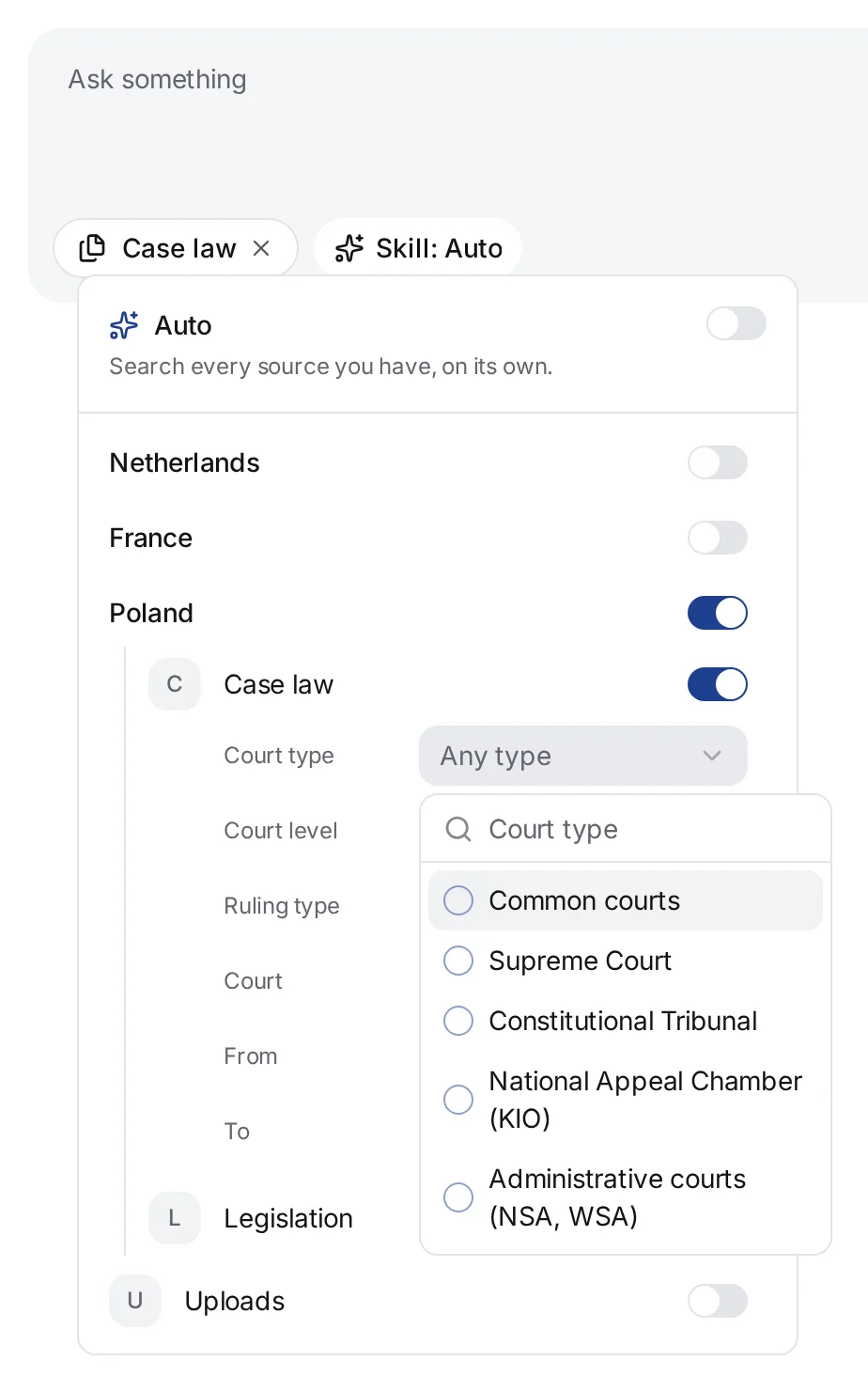
- Court type — the kind of court. Empty, it reads Any type. The list shows:
- Common courts — the sądy rejonowe, okręgowe and apelacyjne;
- Supreme Court — the Sąd Najwyższy;
- Constitutional Tribunal — the Trybunał Konstytucyjny;
- National Appeal Chamber (KIO) — the Krajowa Izba Odwoławcza;
- Administrative courts (NSA, WSA) — the Naczelny Sąd Administracyjny and the wojewódzkie sądy administracyjne. This value finds nothing yet, because the judgments of the administrative courts are not in the collection: see what Poland holds.
- Court level — District courts and KIO, Regional courts, Courts of appeal, or Supreme Court and Constitutional Tribunal. Empty, it reads Any level.
- Ruling type — Judgment (wyrok), Decision (postanowienie), Statement of reasons (uzasadnienie), Resolution (uchwała) or Order (zarządzenie). Empty, it reads Any type.
- Court — see The court filter.
- From and To — the period in which the judgment was given.
Legislation in France and Poland
These two collections have no filters in the list. Put what matters into your question instead:
- France — an article has a wording for each period. jurispraxis.ai reads the wording in force today, unless you give the date of the facts: then it reads the wording in force on that day.
- Poland — jurispraxis.ai reads the newest edition of each act that it holds, and the answer names the edition it quotes. When your facts are older than the act now in force, say when they arose, so that the search can also reach an act that was repealed since.
When to use filters
- You need the view of Poland’s highest court: set Court type to Supreme Court.
- Only the highest courts of the Netherlands or France: set Court level to Highest courts.
- Only the Advocate General’s opinions in the Netherlands: set Document to Opinion of the Advocate General.
- You need recent case law: set From.
- Only appeal decisions in the Netherlands: set Procedure to “Hoger beroep”.
- The results are too wide: narrow them by Area of law.
If you are not sure which filters you need, leave Auto on. jurispraxis.ai then chooses the collections itself, and it can narrow a search by court or by date from what your question says. See Sources and the Auto mode.